South central Indiana
5 nights against 3.42 hours: reserve a 5 night Hoosier National Forest trip from Cincinnati
Five nights in the unglaciated hills of south central Indiana, 137.8 measured miles out from Fountain Square. The whole drive runs 3.42 hours, which works out at 0.68 hour of road for each night booked.
Nothing is held here until the office has written back and you have said yes to what it wrote. No part of a stay is ever paid for through these pages.
- Road from Fountain Square
- 137.8 miles
- Hours at the wheel
- 3.42
- Nights the office books
- 5
- Hours of road per night
- 0.68
- From
- $825 per person
Hours and miles are measured along the road from Fountain Square, not drawn straight on a map, and they assume clear traffic. Your own run will differ with weather, roadworks and the hour you leave.
Five nights against 3.42 hours
Travelers who reserve a 5 night Hoosier National Forest trip from Cincinnati spend 3.42 hours on the road, measured at 137.8 miles from Fountain Square. Split across the nights that are held, the drive comes to 0.68 hour a night. The list in this office is ordered by that one quotient and nothing else, and 0.68 puts this entry at the first of four steps, where the road hardly registers against the stay.
The forest is not one block of trees. It is a long scatter of federal ground across the hills of south central Indiana, stitched between farms, county roads and small towns, running from the reservoir country north of Bedford down to the bluffs above the Ohio River. A stay here means picking one base and letting the rest come to it, because the land is broken into parcels rather than gathered behind a single gate.
Nothing about the place announces itself. The hills are low and steep, the ridges run out in long fingers, and the roads that cross them bend hard. Most of what is worth the trouble sits at the end of a walk of a few hundred yards or a few slopes, not at the end of a paved loop.
Sandstone, hemlock and sinkholes
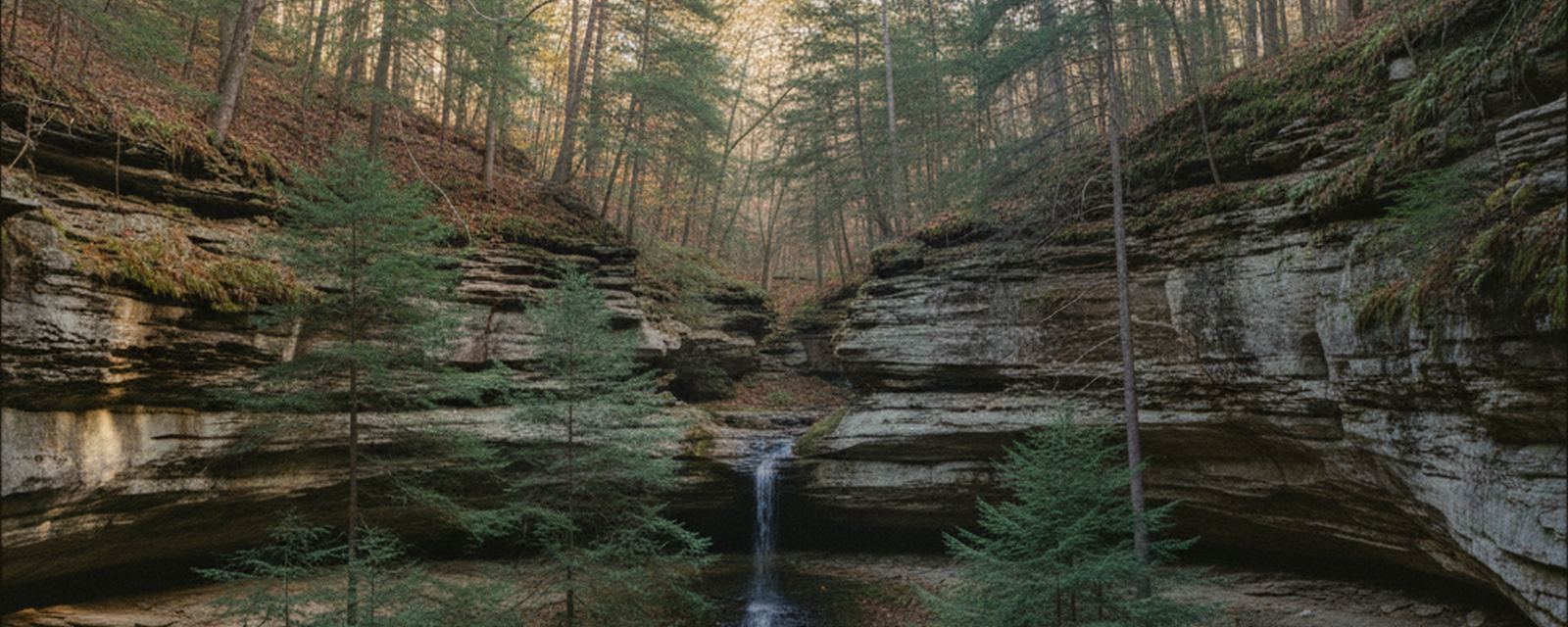
The southern part of Indiana escaped the last glaciers, and that is the whole reason this entry exists. Where the north of the state is flat and plowed, here the sandstone stands up in walls and the creeks have cut box ravines back into it. Eastern hemlock, a tree that belongs farther north and east, holds on in the cold shaded bottoms of those ravines, which is the sort of oddity that makes botanists drive a long way.
Water does the rest of the work. This is karst ground: sinkholes drop out of pasture with no warning, small streams run underground and come back out of a hillside as a spring, and cave systems sit beneath fields that look ordinary from above. After a wet week the ravine walls run with thin falls. After a dry month the same walls are bare stone and moss, and the photographs people arrive expecting are not there.
There are lakes as well, small ones set in old valleys with a ramp, a beach and very little else. And there is old growth. A stand of hardwood near Paoli was never cut, and the trunks are wide enough to change the light under them, which is a different kind of quiet from the second growth that covers most of the region.
Filling five nights from one base
Five nights is enough to take the forest in four directions and still keep a day that goes nowhere. One day belongs to the ravines, where a short steep walk drops into a box canyon under sandstone and climbs back out on the rim. Hemlock Cliffs is the name most people arrive with, and it repays a wet April morning far more than a dry August one.
Another day runs north to the Charles C. Deam Wilderness, the one congressionally designated wilderness in the state, where ridge trails above the reservoir see horses as often as boots and a steel lookout tower stands on Hickory Ridge. A third goes south to the river rim, where the ground ends in a bluff above the Ohio and the towns below were built on stone and river work rather than on visitors.
A fourth day takes in the old growth near Paoli and the quiet ground at Lick Creek, where a free Black farming settlement stood before the Civil War and a cemetery and a few field edges are what remains of it. The fifth day is left open on purpose. It is there so that one rained out morning costs the trip nothing.
What the road shows on the way west
The drive leaves Cincinnati heading west along the Ohio and crosses the state line early. After a short stretch of interstate, most of the distance belongs to US 50, two lanes through Ripley, Jennings and Jackson counties, past grain bins, county seats with a courthouse square, and long fields of corn that stop abruptly where the hills begin.
West of Seymour the ground starts to rise, and the crossing of the East Fork of the White River marks the change. From there to Bedford the cut banks show what the whole region is made of, and Bedford is a limestone town: mill yards stacked with sawn blocks, some of them headed for buildings a long way from Indiana.
The last part is the slowest, and it is why 3.42 hours does not divide neatly into 137.8 miles. Ridge roads, narrow bridges over creeks, a speed limit that drops through every small place on the way. The office measures the drive on that basis rather than on an optimistic average, and prints the result before the price rather than after.
How this reservation is handled
Go Air Travels reserves the lodging and nothing that moves. Transport of every kind sits outside what this office does, and it acts for no company that moves people. The car belongs to the traveler, the keys stay with the traveler, and the driving time is printed up front precisely because the office has no hand in it once the trip starts.
The office is independent. It has no connection with whoever manages the forest and none with whoever owns the rooms, it claims no standing from either, and no payment is taken on this site. A request arrives in writing, the office answers within one business day with what is actually open on the dates asked for, and the terms are set out in that answer before anything is held.
Prices start from $825 per person. The figure covers the nights and the planning set out below, it moves with the season and with how many share a room, and the final number is agreed when the reservation is confirmed.
What the figure holds
- Five nights of lodging near the forest, held in one place so the car stays put between walks.
- A road sheet with the measured 137.8 miles and 3.42 hours from Fountain Square, and the turns that matter written out.
- A plan for all five nights, built around the season asked for and around what is open in it.
- Space for one car at the lodging, confirmed in writing before the day of departure.
- Written confirmation of the reservation, with the cancellation terms set out in the same document.
- One contact at the office for the whole trip, in writing, answered within one business day.
What it leaves to you
- Transport of every kind. Fuel, tolls and anything that happens to the car are the traveler's own account.
- Meals, unless a breakfast belongs to the room and is named in the confirmation.
- Insurance of any kind. This office does not sell it, arrange it or advise on it, and the same holds for visas and passports.
- Fees charged on the day by whoever runs a site, a lake or a program.
- Gear of any sort: boots, packs and anything for the water.
The office adds no booking fee of its own. What you pay is what each supplier charges, and the written offer shows each line separately.
When this one is worth the road
The road is worth it from the back half of March into May, when the ravines still run with water and the old growth floor is covered before the canopy closes over it, and again from the middle of October into early November, when the hardwood turns and the ridges show their shape through it. Summer is green, humid and loud with insects, which suits the lakes and an early start better than a long walk at midday. Winter strips the woods back to rock and makes the overlooks honest, but the water is thin, a number of recreation sites shut for the season, and a cold rain on a ridge road is a long way from help. The office says which of these a set of dates falls into before the reservation is confirmed.
What does 0.68 hour of road per night mean?
It is the whole drive divided by the nights booked. The drive is 3.42 hours over 137.8 measured miles, and the office holds five nights here, so each night takes 0.68 hour of road. Every entry in the list is ordered by that number alone, and 0.68 puts this one at the first of four steps, where the road hardly registers against the stay.
Does the office arrange the drive itself?
No. Go Air Travels reserves lodging. Nothing that moves is booked here, the car is the traveler's own, and the office acts for no company that moves people. What it does with the drive is measure it, print it, and let the figure stand next to the price rather than turn up later.
Can the same place be held for fewer nights?
It can be asked for, and the arithmetic changes with it. The same 3.42 hours spread over fewer nights makes every night take more road, and the entry moves down the list accordingly. The office states the new figure in writing before anything is held.
Nothing in this list moves you. Getting from one place to the next is outside what this office reserves and it signs nothing with any carrier; you take your own car, and the office books what waits at the far end.
Start with the number of nights
Tell the office how many nights you have. Everything else follows from that number, including whether the drive is worth making at all.