Step two of four
212.9 measured miles, and you reserve a 3 night Cumberland Gap trip from Cincinnati, and the road is one morning
The gap stands 212.9 measured miles south of Fountain Square, and the drive takes 4.03 hours. Divided across the three nights the office reserves, each night carries 1.34 hours of driving, which puts this entry on the second step of four: the road is a morning.
Nothing is held here until the office has written back and you have said yes to what it wrote. No part of a stay is ever paid for through these pages.
- Road from Fountain Square
- 212.9 miles
- Hours at the wheel
- 4.03
- Nights the office books
- 3
- Hours of road per night
- 1.34
- From
- $540 per person
Hours and miles are measured along the road from Fountain Square, not drawn straight on a map, and they assume clear traffic. Your own run will differ with weather, roadworks and the hour you leave.
What 1.34 hours a night means here
To reserve a 3 night Cumberland Gap trip from Cincinnati is to accept one morning behind the wheel at each end and nothing worse than that. The measured run is 212.9 miles and 4.03 hours. Three nights divide that into 1.34 hours of driving for every night slept, which is the second step of four on this list. The road is a morning: long enough to plan the day around, short enough that it never becomes the trip.
The office prints that quotient before it describes the place, because the quotient decides whether a stay is worth driving to at all. Nights pull it down. Hours push it up. Three nights were chosen here because the gap holds three separate days without repeating itself, and because the car can then sit parked from arrival until the run home.
Leaving after an early breakfast brings a driver to the foot of the mountain around lunch, with the whole first afternoon and the first evening still unspent.
The run down, and what shows through the glass
The route is interstate for most of its length. South out of Cincinnati, over the river, through the low farm country of central Kentucky and past Lexington, where white fences run along the pasture for stretch after stretch. Corbin is where the interstate part ends. A four lane US highway takes the rest of it south.
The last stretch is the one worth watching. The highway drops into a narrow valley between two long ridges, through Pineville and then Middlesboro, a town that sits inside a crater punched out by a meteor. After that the road goes under the mountain. Twin tunnels opened in 1996 and took the traffic off the top of the pass; a driver enters them in Kentucky and comes out in Tennessee with the gap overhead.
There is no switchback on the way in and no gravel. The turn off the highway into the town is short and signed. Since 4.03 hours is the driving time with nothing in the way, most people put a stop on top of it and leave home accordingly.
A notch in a wall of mountain
The gap is a low place in a ridge that runs unbroken for a long way in both directions, and for two generations it was the practical way west for wagons, herds and families. The track through it was marked in 1775, and the ground still shows what came after: a cut worn deep by hooves and wheels, with the stone of the ridge standing on both sides of it.
When the tunnels opened, the paved road over the saddle was torn out and the pass put back to something near its wagon road shape. Walking up to the saddle now is walking on the restored track. It is a steady climb out of the town, not a scramble, and the ground levels off at the top where the state line runs.
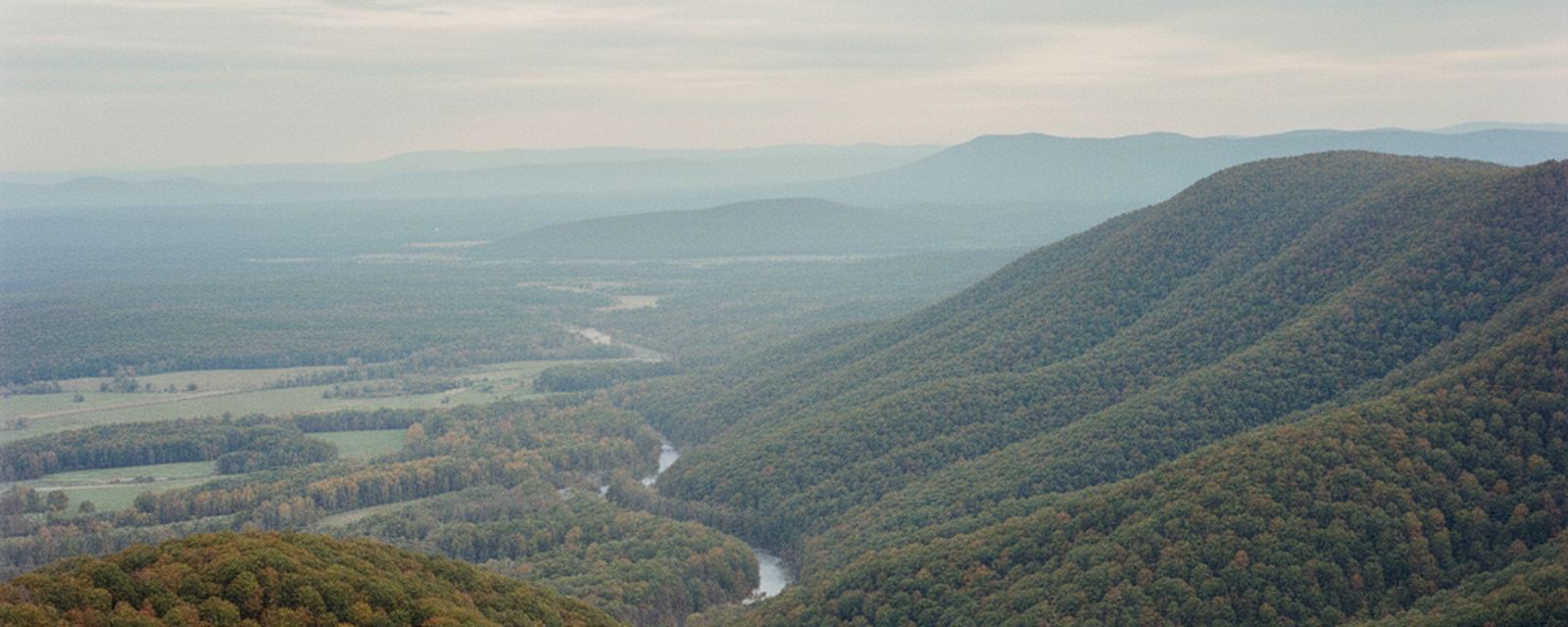
Above the notch three states meet, and a marked climb from the last street in town reaches the spot where they touch. Higher again, a paved road ends at a lookout on the rim called the Pinnacle, with the town, the valley and a long reach of Kentucky laid out underneath it.
Three nights, and what goes in them
The first evening belongs to the town, which is small enough to walk end to end before supper, with the creek running under a low bridge and a stone iron furnace standing cold at the mouth of the trail.
One full day goes on the ridge. The lookout first, early, before the haze lifts off the valley and shortens the view; then the guided walk underground, which stays cool and wet in any month and takes most of an afternoon. Places on it are limited and worth holding in advance.
The second full day goes one of two ways. North over the mountain to a restored settlement of cabins and split rail fences, reached on a rough road in a vehicle that belongs to the park, or east into Virginia to a rebuilt frontier station and the meadows under the white rocks. Either one fills the day. Doing both in a day is not honest planning, and the office will say so if asked.
The town at the foot of the pass
Cumberland Gap is a few blocks of brick storefronts under the mountain, a creek through the middle of them and an old rail line along one side. A general store, a handful of kitchens and little else. The street goes dark early, because the ridge takes the sun off it well before the sky is finished.
The office reserves the nights inside the town when there is room and on the flat ground just south of it when there is not. Either way the car stays still between the two drives, which is what keeps the figure at 1.34 rather than something worse.
Supper is worth thinking about in advance. Kitchens here stop serving early, and a party that rolls in late will find the town shut for the night.
What the figure holds
- Three nights reserved in or just below the town of Cumberland Gap, from $540 per person in a room shared by two
- A written plan of the 212.9 mile run out of Fountain Square, exit by exit, with two sensible stops marked on it
- A place requested on the guided walk underground for one of the three days, subject to the schedule that week
- One off street parking space held for the length of the stay
- A written offer that names the address of the stay, the dates held and the supplier behind every line on it
What it leaves to you
- Fuel and everything else the car asks for over 212.9 measured miles in each direction
- Meals, and anything bought in the town or on the ridge
- Admission to the museum on the college campus south of the gap
- Insurance of any kind, plus visas and passports; all three sit outside what this office handles
- Anything that moves a person. The drive is made in the traveler's own car and no seat on anything is reserved here.
The office adds no booking fee of its own. What you pay is what each supplier charges, and the written offer shows each line separately.
When this one is worth the road
The drive pays for itself twice a year. From late April into early June the ridge is green, the creeks are up and the view from the rim keeps its distance before summer haze flattens it. Then from the last week of September through most of October the slope turns over a few days at a time, and the climb on the restored track goes through color the whole way up. July and August are warm and thick, and the far ridges sit closer than they should. Winter closes things unevenly: ice can shut the paved climb to the rim for days at a stretch, and the walk underground runs on a thinner schedule, though the ground down there holds the same temperature it holds in July.
Does the office arrange any part of the journey?
No. Go Air Travels reserves nights and nothing that moves a person. The drive is made in a private car, on public roads, leaving at whatever hour suits the household. The office measures that drive, writes it out exit by exit, and stops there.
Why three nights and not two?
Because the same 4.03 hours would then be carried by fewer of them, and the entry would fall down the list. Three nights also matches what the place holds: one evening in the town, one day on the ridge, one day on the far side of the pass.
Is the drive hard?
It is long rather than hard. Interstate as far as Corbin, a four lane highway after that, twin tunnels under the mountain, and no switchback anywhere on the way in. The 4.03 hours are measured without stops, so a driver should leave a margin on top of them.
Nothing in this list moves you. Getting from one place to the next is outside what this office reserves and it signs nothing with any carrier; you take your own car, and the office books what waits at the far end.
Start with the number of nights
Tell the office how many nights you have. Everything else follows from that number, including whether the drive is worth making at all.