Step two of four
Reserve a 4 night Big South Fork trip from Cincinnati, a morning of road
218.9 measured miles from Fountain Square, 4.29 hours at the wheel, four nights at the end of it. Each night carries 1.07 hours of driving, which is what puts this entry on the second step of four.
Nothing is held here until the office has written back and you have said yes to what it wrote. No part of a stay is ever paid for through these pages.
- Road from Fountain Square
- 218.9 miles
- Hours at the wheel
- 4.29
- Nights the office books
- 4
- Hours of road per night
- 1.07
- From
- $740 per person
Hours and miles are measured along the road from Fountain Square, not drawn straight on a map, and they assume clear traffic. Your own run will differ with weather, roadworks and the hour you leave.
Four nights set against 4.29 hours
To reserve a 4 night Big South Fork trip from Cincinnati is to accept 218.9 measured miles out of Fountain Square and 4.29 hours at the wheel to get there. Four nights sit at the end of that. Divide the one figure by the other and every night of the stay carries 1.07 hours of driving. That quotient is the only order this office keeps: entries whose road sits light on the nights stand high in the list, entries that ask for a long haul in exchange for a short stay stand low, and this one lands on the second step of four.
The second step has a plain meaning. The road is a morning. Pull out of Fountain Square after breakfast and the gorge is in front of the windshield by early afternoon, with the first day still worth something. It is not a dash and it is not a day lost, and the return is the same road read backward.
The office prints the quotient before the booking rather than after it. A reader who thinks 1.07 hours a night is more driving than four nights can justify is reading the right number and should stop here instead of finding out on a Sunday evening.
What the gorge is made of
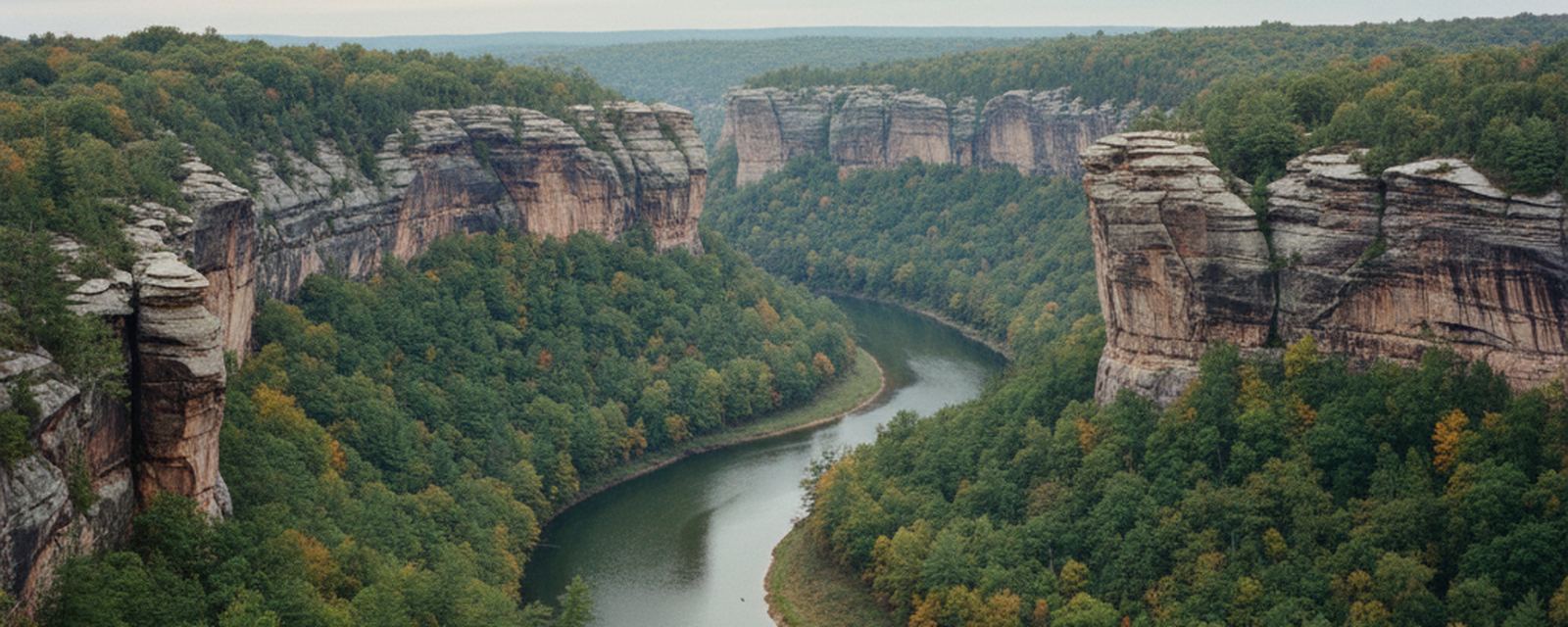
Big South Fork is a sandstone gorge cut into the Cumberland Plateau in northern Tennessee, hard against the Kentucky line. The New River and the Clear Fork meet upstream and become the Big South Fork, and from there the water works north between walls of bluff, past rock shelters deep enough to stand in out of the rain, under spans that weather cut out of the same stone.
It is a worked landscape as much as a wild one. Coal came out of these hollows for a long time, and what the mines left is still legible from a footpath: benches cut along the slopes, adits sealed with concrete, a haul grade flattened into a walking surface. Homesteads sit in the clearings, a chimney and a split fence and an orchard gone back to seed.
Nothing here is polished for arrival. Trailheads are gravel, the overlooks have a stone lip and no glass, and the signal on a phone comes and goes with the rim.
Filling four nights on the plateau
One day belongs to the river at Leatherwood Ford, where the road crosses the water and the walking starts at the bridge. The path that climbs to the Angel Falls Overlook ends on a bare shelf of rock with the whole bend of the river underneath it. Angel Falls is a rapid and not a waterfall, and the name misleads somebody every season.
Another day belongs to Twin Arches, two spans of sandstone on the tableland above the gorge, reached by a gravel spur and a short walk from the end of it. The loop that runs beneath them goes through rock houses and a creek bottom and can be lengthened or cut to suit the legs in the party.
A third day can cross the state line to the old mining camp at Blue Heron, where the buildings were rebuilt as open frames and the words of the people who lived in them are set inside. A fourth can go to Honey Creek, which is a scramble on ladders and hand lines rather than a walk, or to the horse trails, or to nothing whatever. A porch, a creek and a book are a legitimate use of the fourth night, and four nights in one place leave room for that.
The drive, and the part of it that is slow
Out of Cincinnati the route is Interstate 75 and stays that way for most of the 4.29 hours. Bluegrass runs flat and fenced past Lexington, then the ground begins to fold, and by the time the exits thin out the ridges stand close on both sides of the pavement.
The last stretch is the slow stretch. US 27 carries the road south through the coal towns and over the state line, and then Highway 297 leaves Oneida, drops off the rim in switchbacks to the river at Leatherwood Ford and climbs the far side toward Bandy Creek. Anything long behind a hitch takes that descent at a crawl. The 4.29 hours already has it inside.
There is no fuel down in the gorge and the towns before the descent are small ones. Tank up in Oneida and the rest of the week is short local driving on gravel spurs.
How narrow this office is
Go Air Travels books beds and nights. It arranges no transport at all: nothing with a driver, nothing on water, nothing that runs to a timetable. The vehicle is the reader's own, the driving is the reader's own, and the work of the office is the measurement at this end and the reserved room at the other.
The office stands on its own. It is connected with no property, no outfitter and no attraction named on this page, it speaks for none of them, and it has no standing in the gorge beyond that of anybody else who parks and walks in.
Price for this entry is from $740 per person for the four nights, on the basis of the two lists below. What lands on the confirmation moves with the dates, with the number of people in the vehicle and with how the rooms fall, and the whole figure is written out in full before a night is held. Written requests are answered the same working day or the one after it.
What the figure holds
- Four nights at one address, with no move of beds inside the stay.
- Off street parking for one vehicle for the length of the stay.
- The measured road sheet: 218.9 measured miles from Fountain Square, 4.29 hours at the wheel, and the exact route those two figures were taken along.
- A written arrival note with the street address, the arrival window and a number to call from the road.
- One page on what is actually open in the gorge during the dates held, written for those dates and not for the year in general.
What it leaves to you
- Fuel, tolls and everything else the vehicle asks for on the way down and the way back.
- Food and drink of every kind.
- Anything bought on the ground: stables, outfitters, river operators, guided walks. The office books none of them.
- Insurance of any kind. The office does not sell it, does not arrange it and does not advise on it.
The office adds no booking fee of its own. What you pay is what each supplier charges, and the written offer shows each line separately.
When this one is worth the road
Late April into May puts water in the side creeks, the rapids come up and the wildflowers are out on the benches while the bluffs are still visible through thin leaves. Late October hands the plateau over to color and the nights turn cold enough to want a fire. July and August are green, humid and loud with insects, and that is when the swimming holes earn their keep. Winter strips the gorge back to bare rock and opens every overlook, but Highway 297 ices on the switchbacks and that descent is not worth an argument; a stay held in January is confirmed with that warning written into it. In any month the road is a morning, so neither the first day nor the last is spent on the drive.
Does the office arrange any part of the journey?
No. It arranges no transport whatever, in any form. It measures the road from Fountain Square, it reserves the nights at the other end, and it puts both in writing. The vehicle, the route and the driving stay with the traveler.
Why is the driving stated before the place?
Because the driving is the part people misjudge. 4.29 hours spread over four nights comes to 1.07 hours a night, and that single quotient is how every entry in this office is ranked. Stating it after a booking would be too late to be worth anything.
Can the four nights be cut to two?
The office reserves this one as four. Two nights would leave the same 4.29 hours resting on half the beds, the quotient would roughly double and the entry would drop a step. Send the dates in writing and the office will say what can be done with them.
Nothing in this list moves you. Getting from one place to the next is outside what this office reserves and it signs nothing with any carrier; you take your own car, and the office books what waits at the far end.
Start with the number of nights
Tell the office how many nights you have. Everything else follows from that number, including whether the drive is worth making at all.